Air Conditioner Replacement Example for Homeowners
July 16, 2026
Best Ways to Reduce HVAC Bills This Season
July 18, 2026
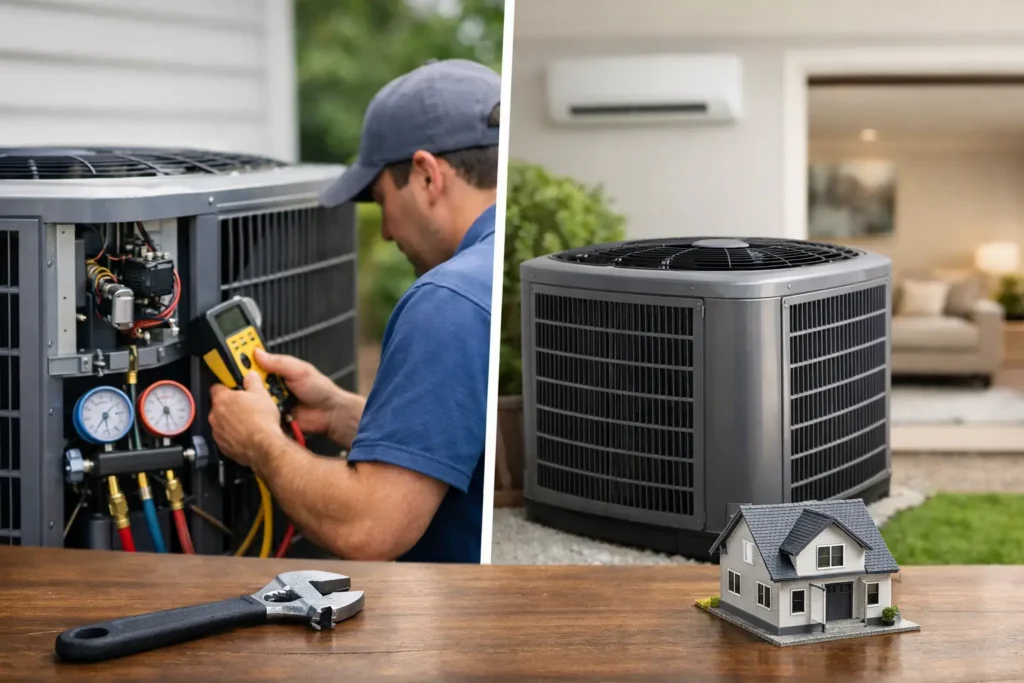
A failed air conditioner on a hot Northern Virginia afternoon creates an immediate question: should you fix it or replace it? AC repair versus replacement is not a decision that should be made on age alone or on the first price you hear. The right choice depends on what failed, how the system has performed, the likely cost of future repairs, and how reliably it can keep your home or business comfortable.
A qualified diagnosis comes first. Some problems that feel major, such as a failed capacitor, clogged condensate drain, thermostat issue, or worn contactor, can often be repaired without replacing the entire system. Other issues point to a system that may no longer be worth putting money into. Knowing the difference protects your comfort and your budget.
Start With the Actual A/C Problem
Before comparing repair costs with a new system, ask what caused the breakdown. A system that will not turn on may have an electrical control issue. Weak airflow can come from a dirty filter, duct restriction, failing blower motor, or frozen evaporator coil. Warm air may signal a refrigerant leak, compressor problem, or a simple setting issue.
The diagnosis matters because each problem carries a different repair outlook. Replacing a small electrical component on an otherwise well-maintained system is very different from replacing a compressor in an older unit with recurring refrigerant leaks. A trustworthy technician should explain the failed part, why it failed, what the repair includes, and what condition the rest of the equipment is in.
For commercial properties, this same step is critical for protecting uptime. A rooftop unit or split system may have a repairable component issue, but repeated failures can disrupt employees, tenants, customers, and temperature-sensitive equipment. The lowest immediate repair cost is not always the lowest operational cost.
When AC Repair Makes Good Financial Sense
Repair is often the practical choice when the system is relatively young, has had dependable maintenance, and needs a contained repair. Most central air conditioners can provide many years of service when installed correctly and cared for consistently. A single breakdown does not automatically mean the equipment is at the end of its life.
Repair may be the better path if the air conditioner is under 10 years old, the repair is modest compared with replacement, and there is no pattern of repeat service calls. It can also make sense when the system has been cooling evenly, controlling humidity well, and operating without unusually high energy bills before the current issue.
A repair is especially reasonable if the failed part does not affect the core condition of the system. For example, fixing a capacitor, fan motor, control board, or drain line may restore reliable operation without requiring a major investment. In those cases, replacing the full system can mean paying for more equipment than the situation calls for.
That said, a repair should solve the cause of the issue, not merely get the system through the week. If a coil freezes because of low refrigerant, adding refrigerant without finding and addressing the leak can lead to another service call and more expense. Ask whether the recommended repair is a lasting correction or a short-term measure.
Signs Replacement Is the Better Long-Term Move
Replacement becomes more compelling when repairs are expensive, frequent, or tied to major system components. An aging air conditioner can still run, but it may need more attention each season and deliver less comfort for the energy it uses.
Consider replacement more seriously in these situations:
- The system is 12 to 15 years old or older and has a major failure.
- Repair calls are becoming a regular expense rather than an isolated event.
- The compressor, evaporator coil, or condenser coil requires a costly repair.
- The equipment uses an older refrigerant that is increasingly expensive or difficult to obtain.
- Rooms stay warm, humidity remains high, or utility bills keep rising despite normal use.
No one of these signs makes replacement mandatory. An older system with a minor issue may still be worth repairing, while a newer system with severe damage may need a different solution. The key is to look at the whole ownership picture: repair history, performance, efficiency, refrigerant, and remaining expected service life.
New equipment can also correct problems a repair cannot. If your current system is improperly sized, struggles with humidity, cycles on and off too often, or leaves parts of the building uncomfortable, a replacement evaluation should include load calculations, ductwork condition, thermostat controls, and installation quality. Simply installing a larger unit is not a reliable answer. Oversized equipment can short-cycle, wear faster, and remove less humidity.
Compare Cost Beyond Today’s Invoice
The popular rule of comparing a repair price with the cost of a new system can be useful as a starting point, but it is not a complete decision tool. A $1,500 repair may be sensible on a well-performing eight-year-old system and difficult to justify on a 16-year-old unit that has already needed multiple repairs.
Think about the next few years rather than just the next few days. If you repair an older unit, what is the likelihood of another costly issue next season? How much more are you paying in electricity because the equipment is inefficient or struggling? Is the current system still meeting your comfort needs? These questions add context to the repair estimate.
Replacement requires a larger upfront investment, so it should come with a clear explanation of the equipment options, warranty coverage, efficiency rating, installation scope, and available financing. A lower-priced proposal is not automatically the better value if it leaves out needed electrical work, drainage improvements, thermostat compatibility, or corrections to airflow problems.
For property managers and business owners, include the cost of downtime in the calculation. An older system that repeatedly fails during occupied hours can create costs that do not show up on an HVAC invoice. Reliability, response time, and a maintenance plan may carry real value for a commercial operation.
Northern Virginia Weather Changes the Stakes
Reston and the broader Northern Virginia area experience humid summers that put real pressure on cooling equipment. An A/C system does more than lower the temperature. It also removes moisture from indoor air. When an aging system cannot keep up, a home can feel sticky at 74 degrees, and a business can become uncomfortable even when the thermostat appears normal.
Summer breakdowns can also limit your options. If replacement is likely, planning it before a complete failure gives you more time to compare equipment, review installation details, and choose a solution based on your needs rather than the next available unit. Preventive maintenance helps create that planning window by catching worn components, drainage issues, dirty coils, and declining performance early.
If the system is still operating, scheduling an assessment before peak heat is often the least stressful way to make the repair-or-replace decision. If it has already failed, same-day service can help determine whether a safe, worthwhile repair is available.
How to Make the Final Call
Ask for a clear repair estimate and an honest assessment of the system’s remaining condition. You should understand whether the repair is expected to restore dependable operation, whether other parts show wear, and what replacement would solve that a repair cannot.
Then weigh three priorities: your immediate budget, your tolerance for future repairs, and your comfort expectations. A homeowner planning to sell soon may make a different choice than one intending to stay for another decade. A business with critical cooling needs may prioritize reliability over extending an older unit one more season.
AAA HVAC can evaluate both options with NATE-certified technicians, explain the trade-offs in plain language, and help Northern Virginia customers move forward without pressure. Whether repair or replacement is the better answer, the goal is the same: dependable cooling when the heat arrives.