Office Cooling Outage: First Steps That Protect Staff
November 21, 2026
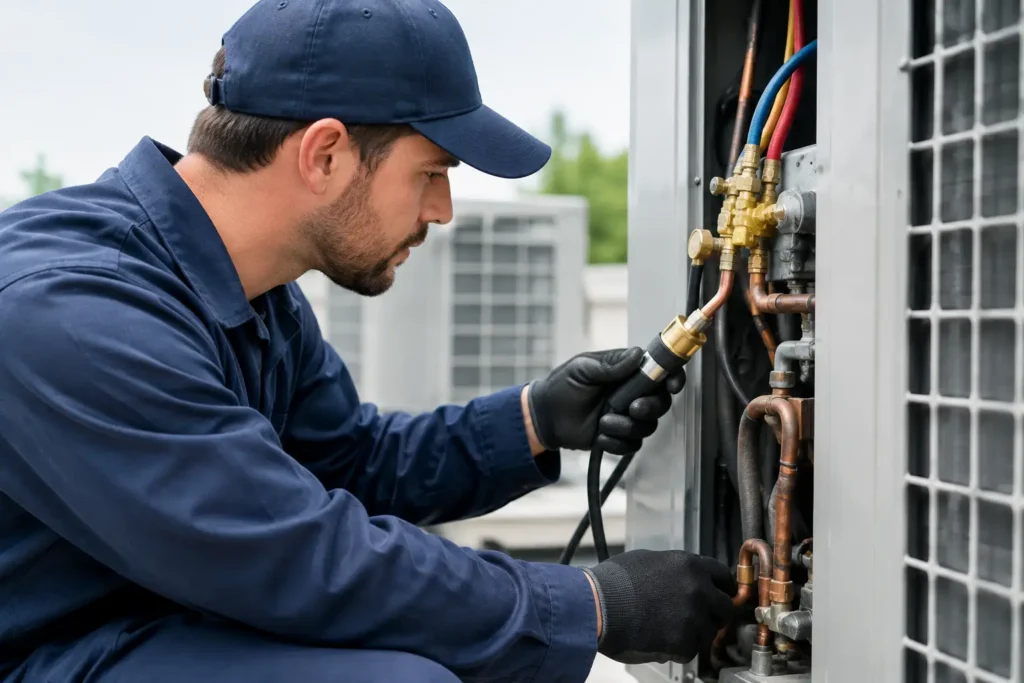
A refrigerant leak can turn a normally comfortable Northern Virginia home or business into a hot, expensive problem fast. So, can refrigerant leaks be repaired? In many cases, yes. But adding refrigerant without finding and fixing the source of the leak is not a repair. It is a short-term refill that can leave you with the same cooling problem weeks or months later.
The right solution depends on where the leak is, the age and condition of your air conditioner or heat pump, the refrigerant it uses, and whether the repair delivers dependable value. A qualified HVAC technician should diagnose the system before recommending a recharge, repair, or replacement.
Can Refrigerant Leaks Be Repaired in an AC System?
Many leaks can be repaired by sealing or replacing the damaged part. Common repairable leak locations include accessible refrigerant line connections, service valves, flare fittings, and certain sections of refrigerant tubing. If a coil has a small, reachable leak, a technician may be able to repair it. In other cases, replacing the evaporator coil, condenser coil, or damaged line is the more reliable option.
There is no one-size-fits-all answer because the leak location matters as much as the leak itself. A loose fitting is usually a much different repair than corrosion throughout an indoor coil. A system with one isolated leak may be worth repairing, while an older unit with repeated coil failures may be nearing the point where replacement makes better financial sense.
Refrigerant is not a fuel that an air conditioner normally uses up. It circulates through a closed system. When levels are low, the system has likely leaked refrigerant and needs professional attention.
Signs Your System May Have a Refrigerant Leak
Weak cooling is the symptom most homeowners notice first. Your AC may run for long periods but struggle to lower the temperature, especially during a hot afternoon. You may also find that certain rooms never seem to catch up.
Other warning signs include warm air from supply vents, ice buildup on refrigerant lines or the indoor coil, a hissing sound near the equipment, and unexpectedly higher electric bills. A heat pump can show similar issues in cooling mode and may perform poorly when heating during colder weather.
These signs do not prove that refrigerant is leaking. A dirty filter, airflow restriction, failing blower component, thermostat issue, or compressor problem can produce overlapping symptoms. That is why a proper diagnosis protects you from paying for the wrong repair.
How HVAC Technicians Find a Leak
Finding a refrigerant leak can take more time than fixing a simple connection once it is located. The technician first checks system performance, refrigerant pressure readings, airflow, and visible condition of coils and lines. From there, leak detection may involve an electronic detector, ultraviolet dye, soap-bubble testing at accessible joints, or pressure testing with nitrogen.
The best method depends on the equipment and suspected leak location. Small leaks can be difficult to identify, particularly inside coils, behind insulation, or in areas affected by ongoing vibration and corrosion. A thorough technician does not guess based only on a low-pressure reading.
After the repair, the system should be pressure tested and evacuated to remove moisture and non-condensable gases before the correct amount of refrigerant is added. This process helps preserve efficiency and reduces the chance of another performance issue caused by improper charging.
What Does a Refrigerant Leak Repair Involve?
For a damaged fitting or valve, the repair may involve tightening, replacing, or brazing the connection. If a refrigerant line has rubbed against another surface and developed a hole, the affected section may be repaired or replaced and protected from further wear.
Coil leaks require closer judgment. Aluminum and copper coils can corrode over time, particularly in equipment exposed to moisture, household chemicals, or harsh outdoor conditions. While some coil leaks can be repaired, a patch is not always the best long-term answer. If corrosion is widespread or the coil has leaked before, coil replacement may offer more dependable results.
Avoid products marketed as leak sealants unless a qualified technician specifically recommends one for your situation. Sealants can create problems inside precision HVAC components and may complicate future service. A physical repair or component replacement is generally the more accountable approach.
Repair or Replace: When Does Each Make Sense?
A refrigerant leak does not automatically mean you need a new air conditioner. Repair is often a practical choice when the unit is relatively new, the leak is isolated, replacement parts are available, and the rest of the system is in good condition. It can also make sense when the equipment uses a currently supported refrigerant and has a solid maintenance history.
Replacement becomes a stronger consideration when the system is older, has suffered repeated leaks or compressor trouble, or needs a costly major component. The refrigerant type is also a major factor. Older systems that use R-22 can be especially expensive to maintain because that refrigerant is no longer produced or imported for new use in the United States. Repaired R-22 equipment can still operate, but the cost and availability of recovered refrigerant may affect the value of another major repair.
For commercial property managers, the decision also involves operational risk. An aging unit may be repairable, but recurring outages can disrupt employees, tenants, customers, and temperature-sensitive areas. Comparing a repair estimate with expected reliability, energy costs, warranty coverage, and replacement options provides a clearer business decision than focusing on the initial repair price alone.
A good HVAC recommendation should explain the problem plainly. You should know where the leak is believed to be, what repair is proposed, whether the repair carries a warranty, and what alternatives exist if the repair is not the best investment.
Why a Recharge Alone Is Not Enough
A refrigerant recharge may restore cooling temporarily, but it does not solve an active leak. If the refrigerant escapes again, efficiency drops, cooling capacity declines, and system components can face added strain. Low refrigerant can contribute to coil icing and, in severe cases, compressor damage.
There is also an environmental reason to repair leaks correctly. Refrigerants must be handled and recovered by properly certified professionals. Releasing refrigerant is not a DIY task, and attempting to add refrigerant without the right tools, training, and diagnosis can create safety, legal, and equipment problems.
If a technician recommends a recharge after a repair, that is different from simply topping off a leaking system. The refrigerant charge should be set according to manufacturer specifications after the leak has been addressed and the system has been tested.
How to Reduce the Risk of Future Leaks
Not every refrigerant leak is preventable, but regular maintenance can catch loose connections, worn insulation, coil corrosion, and developing performance issues early. Keeping the outdoor unit clear of debris, changing filters on schedule, and addressing unusual noises or weak cooling promptly can help prevent a small issue from becoming a more costly failure.
Annual professional maintenance is especially useful before peak cooling season. During a visit, a technician can evaluate refrigerant-related performance along with electrical components, drainage, airflow, and the overall condition of the system. That gives homeowners and facility teams a better chance to plan repairs instead of facing an emergency during a heat wave.
When your system is not keeping up, ask for a diagnosis that identifies the cause rather than a quick refill. AAA HVAC can help Northern Virginia homeowners and businesses assess refrigerant leaks, explain the practical options, and complete repairs with qualified service. The most useful next step is simple: address the problem while it is still a repair decision, not an avoidable breakdown.