HVAC Technology Trends That Matter Now
July 6, 2026
Commercial HVAC Service Contracts Explained
July 8, 2026
A commercial HVAC problem rarely starts with a total shutdown. More often, it begins with a hot conference room, a tenant complaint, a spike in energy bills, or a rooftop unit that runs longer than it should. If you are responsible for building comfort, learning how to maintain commercial HVAC systems is one of the most practical ways to avoid disruption, control costs, and extend equipment life.
Commercial equipment works harder than most people realize. It may serve offices, retail floors, restaurants, medical spaces, or mixed-use properties with different occupancy patterns and comfort demands. That means maintenance is not just about preventing breakdowns. It is about protecting uptime, indoor air quality, and day-to-day business operations.
Why commercial HVAC maintenance matters
When maintenance gets delayed, the costs usually show up in places that are easy to miss at first. Energy use climbs because dirty coils, clogged filters, and failing components force the system to work harder. Comfort becomes inconsistent because airflow drops or controls drift out of calibration. Then small issues turn into urgent repairs.
For property managers and business owners in Northern Virginia, seasonal swings add pressure. Cooling equipment can face long, humid summers, while heating systems need to perform through freezing winter conditions. A neglected system may survive for a while, but it is more likely to fail when demand is highest. That is usually the worst possible moment.
How to maintain commercial HVAC with a workable plan
The best maintenance plan is not the most complicated one. It is the one that matches the building, the equipment, and the operating schedule.
A small office with one or two packaged rooftop units will not need the same maintenance frequency as a restaurant, medical facility, or high-traffic retail site. Systems in dusty environments, buildings with long operating hours, or properties with strict ventilation requirements usually need more attention. This is where many owners run into trouble. They use a one-size-fits-all schedule for equipment that does not operate under one-size-fits-all conditions.
A good plan includes routine inspections, filter changes, coil cleaning, drain checks, electrical testing, control verification, and seasonal service before heavy heating or cooling demand begins. It should also include documentation. If no one is tracking what was inspected, cleaned, repaired, or recommended, it becomes much harder to spot patterns before they become expensive failures.
Start with filters, airflow, and cleanliness
If there is one maintenance task that affects almost everything else, it is airflow. Restricted airflow can strain motors, reduce heating and cooling performance, and create uneven temperatures across the building.
Filters need to be checked on a schedule that reflects actual use, not guesswork. In some commercial spaces, monthly checks make sense. In others, replacement may be needed even sooner because of dust, construction activity, cooking, or high occupancy. Waiting too long can lead to frozen coils, overheated components, and unnecessary wear.
Clean coils matter just as much. Evaporator and condenser coils collect dirt over time, which reduces heat transfer and forces the system to run longer. Longer run times mean more energy use and more stress on parts. The same idea applies to blower wheels, vents, and return air paths. Dirt may seem minor, but in HVAC equipment it changes performance fast.
Pay attention to electrical components and controls
Commercial HVAC systems depend on a long list of electrical parts working correctly under load. Contactors, capacitors, relays, wiring connections, sensors, and thermostats all affect system performance. When one piece starts to weaken, the rest of the system can suffer.
Loose electrical connections can create heat, voltage imbalance, or intermittent failures that are hard to diagnose after the fact. Controls that are out of calibration can make a space too warm, too cold, or unnecessarily humid. A thermostat issue may look like an equipment issue when it is actually a control problem.
This is one reason preventive maintenance is more cost-effective than emergency-only service. During a planned visit, a technician can test components before they fail completely. Replacing a weak capacitor during maintenance is far less disruptive than losing cooling during business hours because the unit would not start.
Check drains, refrigerant, and moving parts
Drain lines and condensate systems do not get much attention until there is a leak. In a commercial setting, that can mean stained ceilings, damaged finishes, or water near occupied areas. Drain pans should be inspected and lines should be cleared before buildup becomes a problem.
Refrigerant levels also matter, but this is an area where assumptions can cause trouble. Low refrigerant is not part of normal operation. If a system is low, there is usually a leak or another issue that needs repair. Simply adding refrigerant without diagnosing the cause may restore cooling temporarily, but it does not solve the underlying problem.
Belts, bearings, motors, and fan assemblies should also be inspected regularly. Worn belts can slip and reduce airflow. Bearings can create noise before they fail. Motors may start drawing higher amperage as they age or as airflow becomes restricted. These are all warning signs that maintenance can catch early.
Schedule service by season, not just by calendar
Commercial HVAC maintenance works best when it is timed around operating demand. Cooling systems should be inspected before summer loads arrive, and heating systems should be checked before cold weather sets in. Waiting until the season starts often means competing for service during the busiest times of year.
Spring maintenance typically focuses on condensers, refrigerant performance, drain systems, economizers, and cooling controls. Fall maintenance usually centers on burners, heat exchangers, ignition systems, safety controls, and airflow related to heating performance. For heat pumps or buildings with year-round equipment use, the schedule may need to be tighter.
This seasonal approach matters because some problems only show up when equipment is tested in the mode it is about to rely on. A unit that seemed fine in mild weather may struggle once the building faces extreme heat or cold.
Keep records and watch for patterns
One of the most overlooked parts of commercial HVAC maintenance is recordkeeping. Service notes, filter change dates, repair history, and operating concerns provide a useful picture over time.
If the same unit keeps losing airflow, tripping safeties, or needing refrigerant work, that is not random. It may point to a design issue, a recurring component failure, or an aging system nearing replacement. Records also help with budgeting. Instead of being surprised by a major repair, you can see when maintenance costs are rising and plan ahead.
For businesses with multiple units or multiple properties, this becomes even more valuable. Good records help prioritize what needs immediate attention and what can be monitored.
Know what your team can handle and what needs a pro
Some basic upkeep can happen in-house. Staff can watch for unusual noise, visible leaks, blocked vents, dirty outdoor coils, or thermostat complaints. They can also help ensure mechanical spaces stay clear and units are accessible for service.
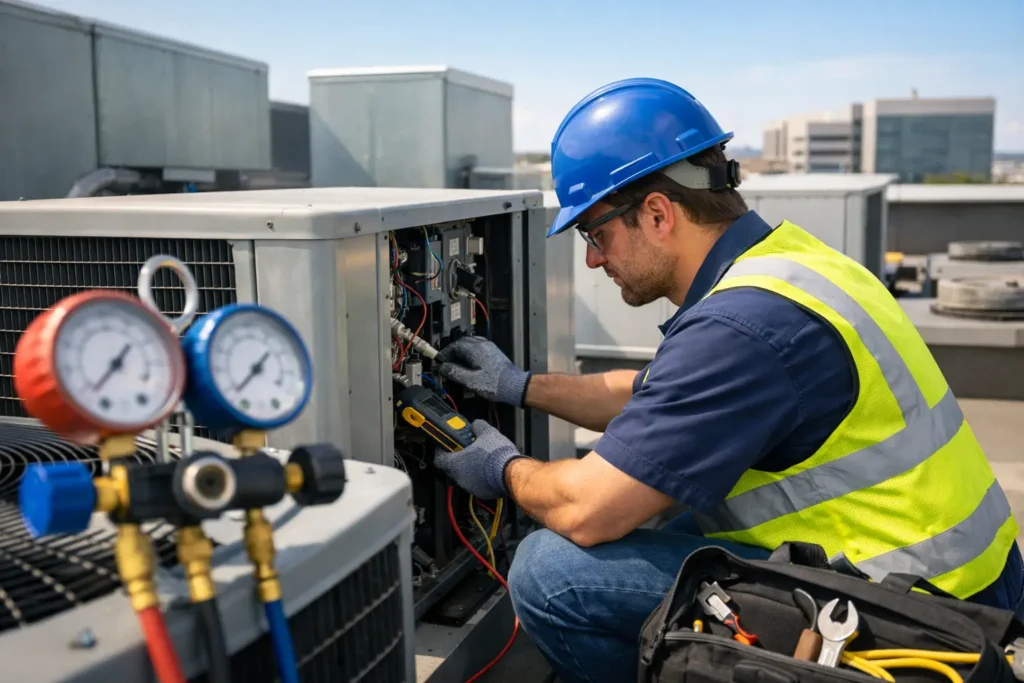
But commercial HVAC maintenance should not rely on visual checks alone. Electrical testing, refrigerant diagnostics, combustion analysis, control calibration, and internal component inspection require trained technicians. That is especially true for larger or more complex systems where a wrong adjustment can create bigger issues.
For many businesses, the right move is a preventive maintenance agreement with a qualified commercial HVAC provider. That creates a regular service schedule, reduces the risk of missed inspections, and gives you a faster path to repair when something does go wrong. In a market like Northern Virginia, where weather can push equipment hard, that consistency matters.
When maintenance is no longer enough
Even well-maintained systems eventually reach a point where repairs become less practical. If a unit is breaking down often, struggling to maintain comfort, or driving up operating costs, it may be time to compare ongoing repair expense against replacement value.
This is not always a simple call. A newer system with one major repair may still be worth keeping. An older unit with repeated issues, obsolete parts, and poor efficiency may not be. The right answer depends on age, condition, performance, and how critical that equipment is to your building operations.
A dependable contractor should be clear about that trade-off. Maintenance should extend useful life, not delay an obvious replacement so long that your business pays more in downtime and emergency service.
If you want fewer surprises from your building systems, the goal is straightforward: treat maintenance as an operating priority, not an afterthought. A steady maintenance plan, qualified service, and quick action on early warning signs will do more for comfort and cost control than any last-minute repair call ever will.